
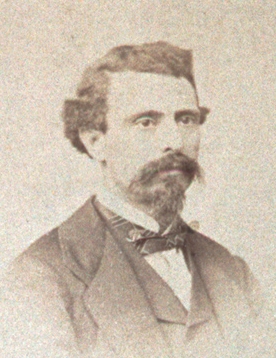
Socrates Newman was for many years a conspicuous figure in the business circles of St. Louis, and prominent also as a public official and in political circles, was born October 21, 1826, in St. Louis, and died at his home in Iron County, Missouri, July 25, 1893. His father was Captain Jonas Newman, who, during his life, was prominently identified with the Mississippi River trade, and his mother, who was Susanne LeBeaume before her marriage, belonged to one of the old French families of St. Louis, and was a sister of the well-known and wealthy Louis A. LeBeaume. Reared in St. Louis, Mr. Newman was educated in part at St. Louis University and in part at Bardstown, Kentucky, being fitted by his course of study for a business career.
Soon after leaving school he went to Franklin County, Missouri, where his uncle, Peter E. Blow, was engaged in lead mining and merchandising operations. There he became associated in business with Mr. Blow, and while a resident of Franklin County, developed a marked taste for politics, and also a very superior ability as a political manager. Defeating through his efforts, a candidate — for the office of County Clerk — who had held the office for many years, and who was so strongly entrenched in popular favor that it was thought he could not be beaten.
Soon after leaving school he went to Franklin County, Missouri, where his uncle, Peter E. Blow, was engaged in lead mining and merchandising operations. There he became associated in business with Mr. Blow, and while a resident of Franklin County, developed a marked taste for politics, and also a very superior ability as a political manager. Defeating through his efforts, a candidate — for the office of County Clerk — who had held the office for many years, and who was so strongly entrenched in popular favor that it was thought he could not be beaten.
In 1849, he returned to St. Louis and followed various minor occupations until 1852, when he was elected to the office of City Registrar, a position which he filled for two years thereafter. Shortly after 1854 he was appointed Clerk of the Circuit Court to fill a vacancy which had occurred in that office. After holding this office a few months he formed a co-partnership with George C. Graham and embarked in the iron foundry business as junior member of the firm of Graham & Newman.
This foundry was parent of the present large establishment of Shickle, Harrison & Howard; and in this connection it is appropriate to call attention to the fact that Graham & Newman manufactured the first large water mains laid down in the city of St. Louis. For many years this firm also manufactured gas retorts, which were then made of iron, and not, as now, of fire-clay, and Mr. Newman and his partner also built the gas-works at Hannibal, Missouri.
Thoroughly imbued with the spirit of progress, and confident that St. Louis was to become a great city, he planned and erected — early in the decade beginning with 1860, and soon after his return from a European trip — the large iron and marble building located on the south side of Olive Street, between Second and Third Streets, and immediately in the rear of the old postoffice building. It turned out that the time was not ripe for the building of so pretentious a structure, and for many years he jestingly spoke of this enterprise as “Newman’s folly.” The business depression incident to the Civil War, and the death of Mr. Graham, caused him to dispose of his foundry interests, and from 1864 until 1868 he was not actively engaged in business. In 1869, however, he engaged in the fire insurance business with W. H. Pritchartt as junior member of the firm of Pritchartt & Newman, which had its offices at the corner of Second and Pine Streets, opposite the Boatman’s Bank. In 1876, he was appointed by the circuit court receiver of the St. Louis Gas Light Company, subsequently becoming manager and then president of that corporation, retaining the last-named position until failing health compelled him to retire from active business, in 1889.
He was a man of very superior executive ability, keen sagacity and large enterprise, and proved himself a valuable citizen of St. Louis in many ways. His wealth and social prominence gave him great influence in the circles in which he moved, and this influence was always wielded to advance the interests of the city and promote its growth and prosperity. Although the only public offices which he held during his residence in St. Louis were those of Clerk of the Circuit Court and City Registrar, of which mention has already been made, he was an influential factor in the politics of the city for a score of years. He was tendered the position of City Collector by Mayor Overstolz, but declined that office, then the best in the mayor’s gift, in favor of his friend, General John D. Stevenson.