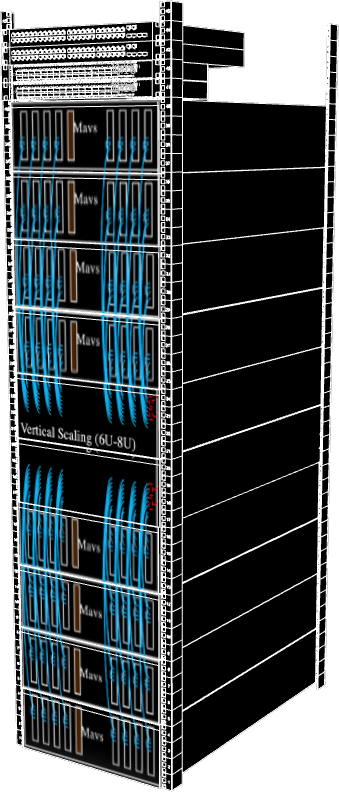
The Miwok cluster is a high-performance computing system built upon KnuEdge’s innovative HERMOSA and LambdaFabric neural computing architecture. This architecture distinguishes itself from traditional CPU/GPU/FPGA systems by employing a non-von Neumann design optimized for neural signal processing. It features:
HERMOSA Processors: These processors offer a high degree of scalability, low latency, and a multi-core, low-wattage design.
Neural Computing Focus: The system is specifically designed to accelerate machine learning, artificial intelligence, and pattern recognition tasks.
Origin at Calit2: The core technology has roots in research conducted at the California Institute for Telecommunications and Information Technology (Calit2), specifically within the Qualcomm Institute at UC San Diego.
Pattern Recognition Laboratory: The Miwok cluster served as a component of Calit2’s Pattern Recognition Laboratory, enabling researchers to explore advanced Big Data analytics and machine learning applications.
Pacific Research Platform (PRP) Access: Researchers across the 20-campus PRP had access to the Miwok cluster, expanding its potential impact
Production Servers
SuperMicro SYS-4028GR-TR
Up to eleven full-length, full height PCIe cards
Configurations: one QSet, two QSets, one QSet and 1 to 4 QCCs, eight QCCs.
Dual E5-2680V3 2.5 G 30 M 9.6 GT 120 W processors
16 32 GB DDR4-2133 2Rx4 LP ECC DIMMs
4 Intel S3610 400 GB STAT 6 Gb/s drives
A 3D rendering of a MIWOK cluster, which consists of 8 hosts operating as 64 thousand (64k) tdsps HERMOSA chips interconnected with the Knuedge Lambda Fabric IP
The Miwok cluster is intended for a wide range of applications, including:
Computational Science: Supporting research that relied on high-performance computing, particularly in areas involving pattern recognition.
Big Data Analytics: Processing and analyzing large datasets for pattern recognition and insights.
Machine Learning and Artificial Intelligence: Accelerating the development and execution of complex AI algorithms.
Pattern Recognition: Identifying patterns in various data types, such as images, audio, and sensor data.
Cloud-Based Machine Learning: Providing high-performance computing resources for cloud-based AI applications.
Internet of Things (IoT) Applications: Processing data from IoT devices for real-time analysis and decision-making.