Enrico Caruso (1873-1921), an Italian operatic tenor who moved from lyric to dramatic roles, achieved worldwide fame not only through his acclaimed performances in major opera houses across Europe and the Americas, but also as a pivotal figure in the nascent recording industry. Recognized as the first international recording star, Caruso embraced the technology of his time, producing approximately 250 commercially released recordings from 1902 to 1920. This willingness to utilize and popularize early recording technology transformed him into a global sensation, driving the sales of gramophones and bringing opera to a wider audience. His voice, uniquely suited to the recording process, spurred the development of recording techniques and demonstrated the vast commercial potential of recorded music, effectively laying the groundwork for the modern music industry.
Caruso, c. 1910
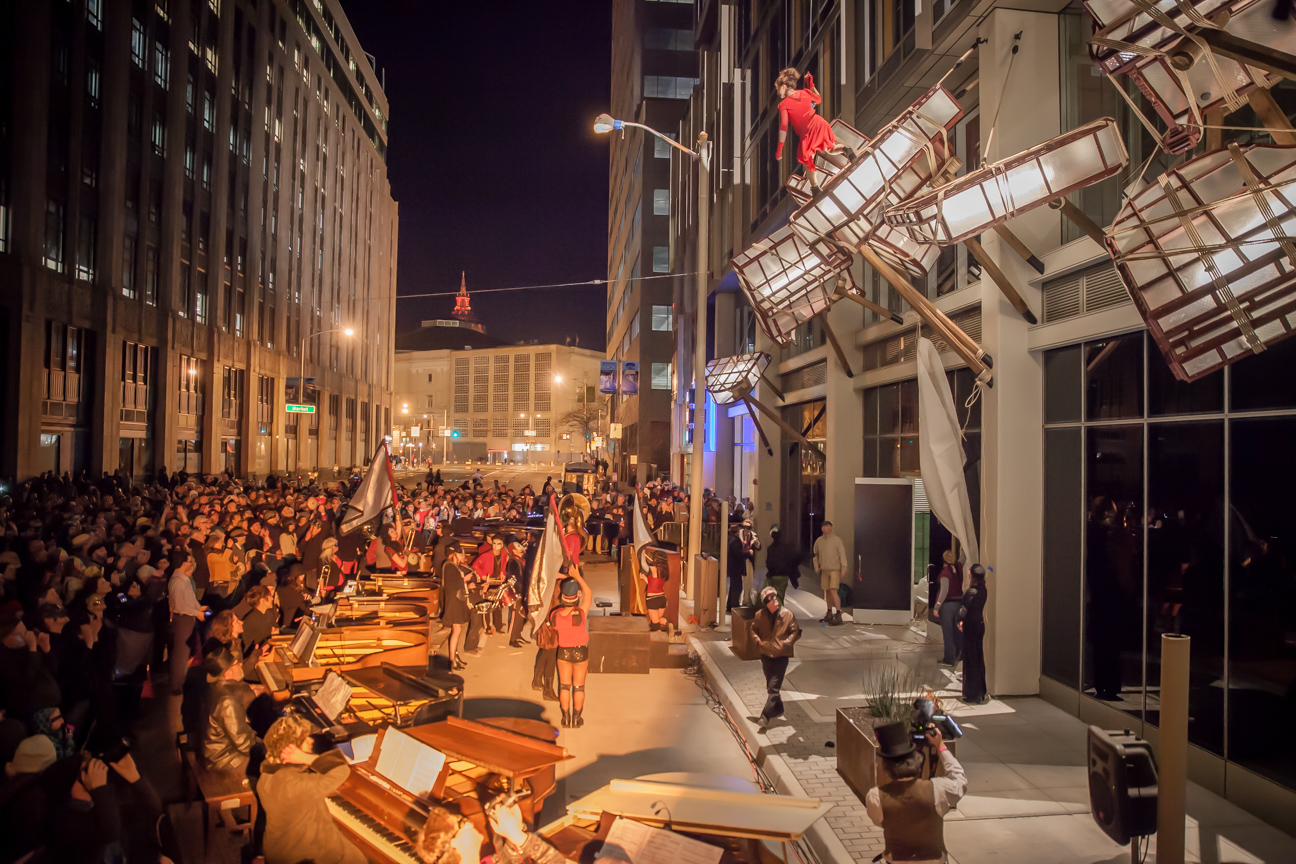
“Caruso’s Dream,” a permanent public art installation, transforms a San Francisco cityscape into a captivating tribute to the legendary Enrico Caruso. Artists Brian Goggin and Dorka Keehn sought to create an experience that transcended simple visual display, aiming to weave together Caruso’s timeless recordings with a dynamic, responsive light show. Thirteen piano sculptures, each a testament to repurposed industrial materials, are suspended above the sidewalk, each containing clusters of warm, white LEDs. Their vision was to craft a visual echo of Caruso’s voice, a tangible representation of the emotional depth within his historic recordings.
The project presented significant technical challenges from the outset. The “low-resolution” canvas, limited to thirteen individually controllable light units, fixed in position, and capable of only brightness modulation, stood in stark contrast to the rich, multi-dimensional nature of Caruso’s voice . The challenge was multifaceted: crafting a compelling visual narrative that could stand alone, independent of the accompanying AM broadcast, yet also resonate deeply with those who chose to immerse themselves in the full audiovisual experience. Furthermore, the installation demanded a system capable of long-term reliability and minimal maintenance, a crucial consideration for permanent public artwork.
A significant figure in earthquake engineering, Henry John Degenkolb (1913-1989) left a lasting impact on structural design in San Francisco. He co-established Degenkolb Engineers, a firm responsible for the structural integrity of many Bay Area buildings. Degenkolb’s dedication to post-earthquake analysis led him to numerous disaster zones, where he gathered and disseminated vital lessons. He also contributed significantly to the field as president of the Earthquake Engineering Research Institute (EERI). Degekolb’s firm is still active to this day and a key aspect of ensuring the safety and structural integrity of the suspended sculptures was the critical role of the seismic engineers from Degenkolb. Their precision 3D models, meticulously crafted and simulated in Dassault Systems SolidWorks, were also essential for visualizing and planning the installation.
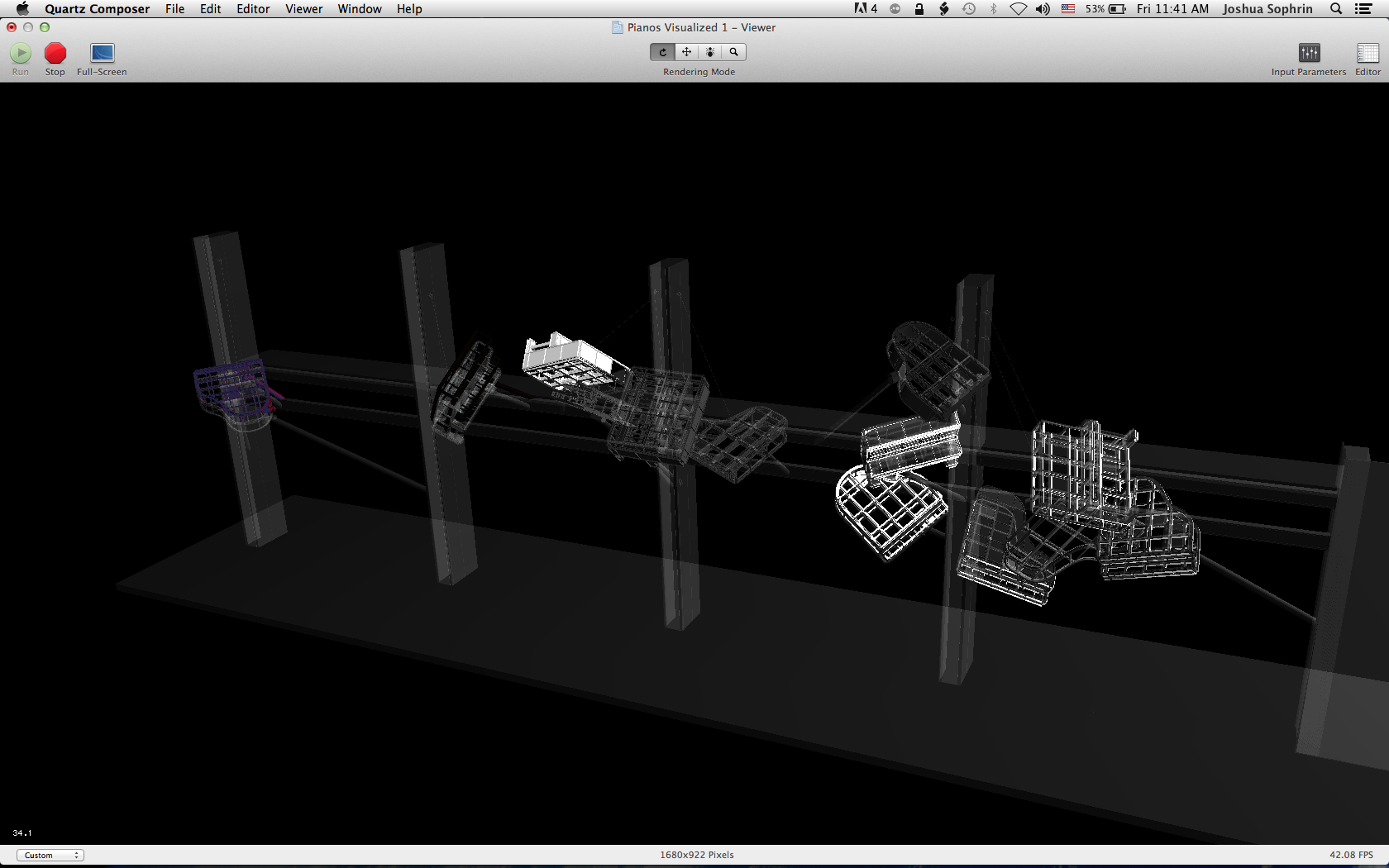
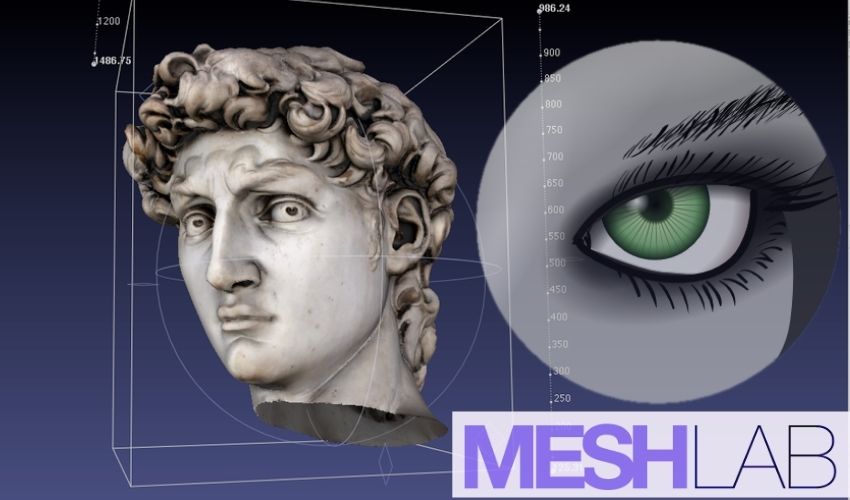
J. de Salis-Sophrin & Associates, Inc. played a crucial role in integrating the work of the structural engineers and artists teams by exporting and then converting each of the pianos from the detailed engineering CAD models into a file formats that were then imported into open source MeshLab, where they were modified, converted and then loaded into a custom Quartz Composer real-time programming environment.
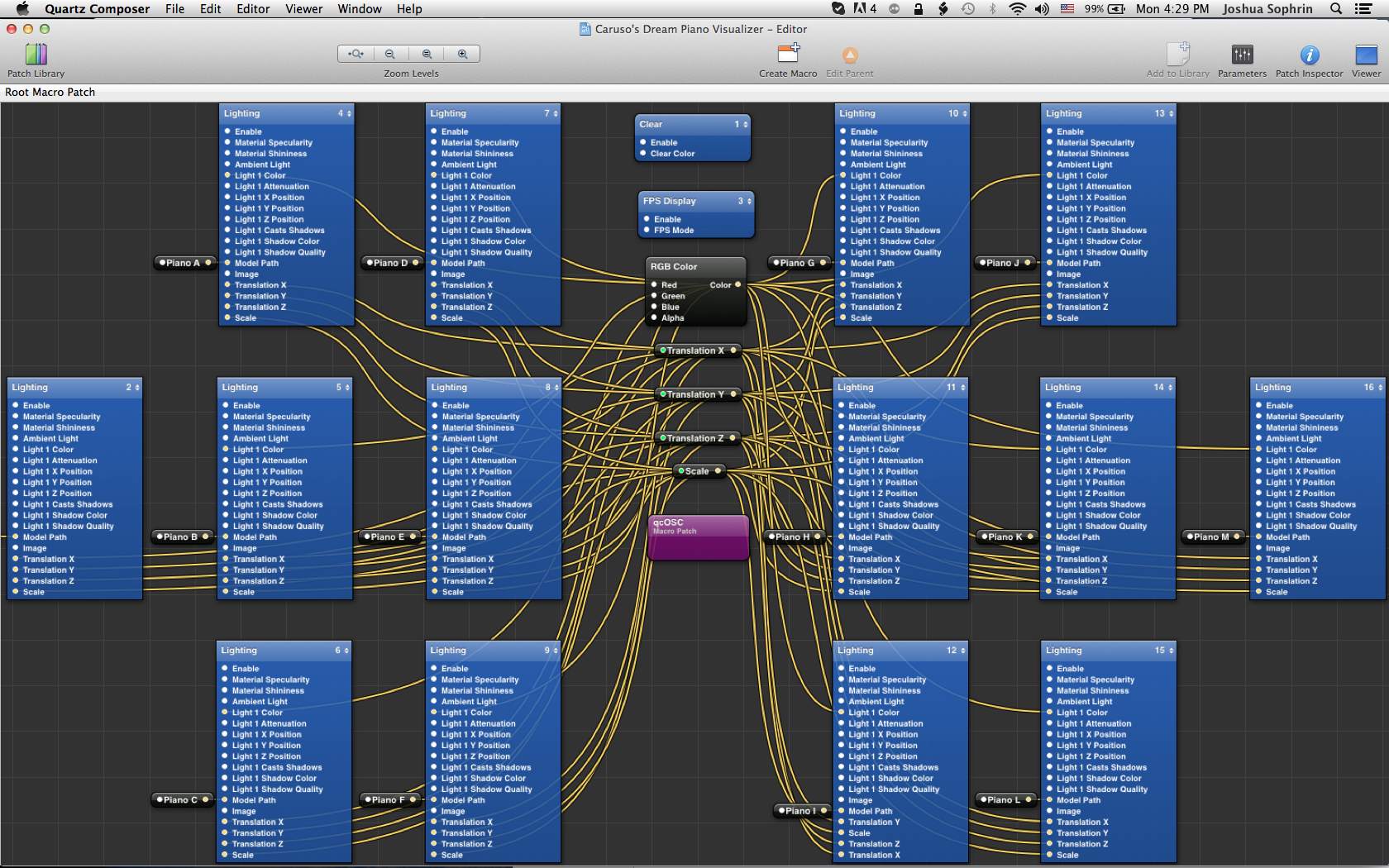
This provided a highly accurate virtual pre-visualization of the sculpture’s spatial composition, allowing the team to understand the physical relationships of the pianos, while also being able to manipulate color accurate lighting sources in a real-time digital environment.J. de Salis-Sophrin & Associates work in importing the seismic engineers’ models allowed for the artist group to meticulously program the light sequences before the physical installation was complete, ensuring seamless translation of artistic intent to the three-dimensional sculpture. Smoothing techniques were also implemented, preventing the lights from becoming jarringly intense and ensuring a more harmonious visual experience.
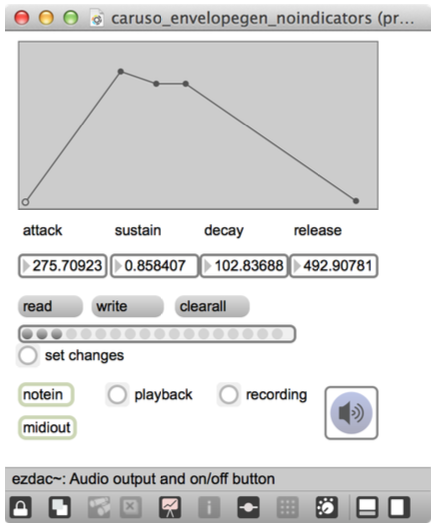
MIDI-controlled envelope generator
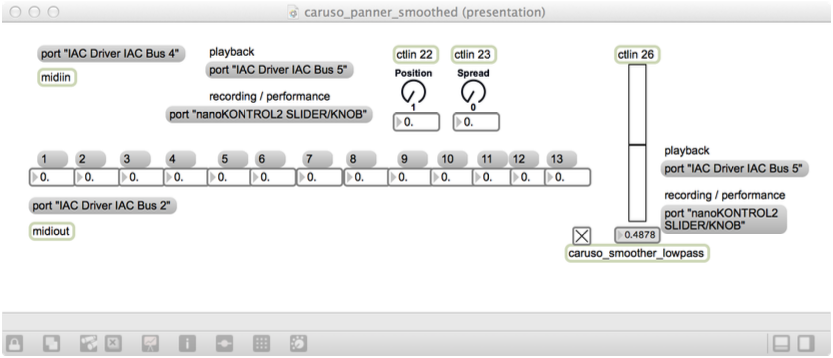
Max instrument for spreading and moving light through sculpture
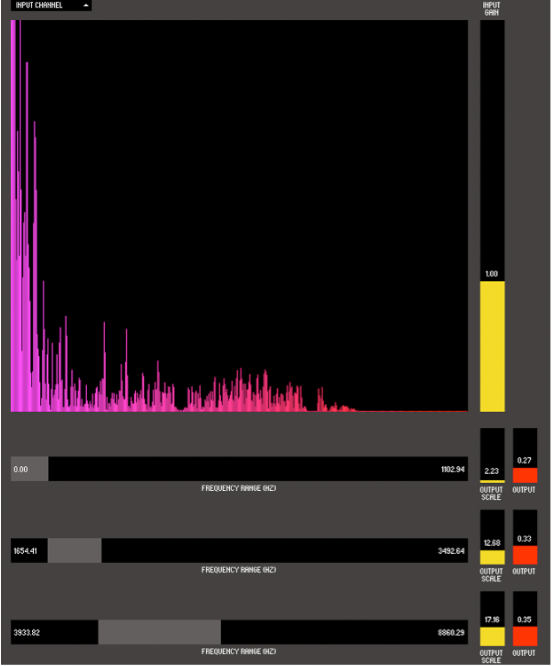
FFT Control software (ChucK with a Processing sketch, communicating via OSC)
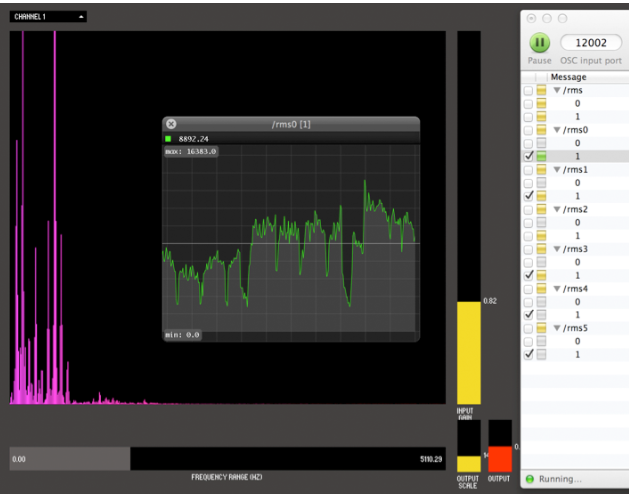
Osculator's "Quick Look" window floats above FFT Control, graphing the OSC signal being sent as a result of audio analysis
To further bridge the gap between artistic vision and technical reality, audio analysis, specifically spectral analysis, became the foundation of the light compositions. Building on top of the real-time visualization system, collaborating artist Gabriel Ray-Goodlatte (Herb Alpert School of Music Music Technology: Interaction, Intelligence & Design) developed custom-designed software, FFT Control, to dissect Caruso’s recordings, extracting the nuanced dynamics of his voice. This data was then translated into MIDI signals, which in turn drove the intensity of the LED lights. Complementing this, Gabriel also designed and implemented the MIDI control and signal routing within Max/MSP, enabling dynamic movement and the representation of individual musical elements.
The overarching artistic goals were deeply intertwined with the technical solutions. The project aimed to visually embody Caruso’s voice, to evoke a sense of historical nostalgia, and to create a public artwork that could be appreciated on multiple levels. The final system, designed for permanence, synchronizes the light sequences with the AM broadcast of Caruso’s recordings, illuminating the sculptures nightly from dusk until dawn. This installation stands as a testament to the power of interdisciplinary collaboration, where art, technology, and engineering converge to create a truly immersive and evocative public experience.